


 Topic
Topic Haptic Panels: the silent language of surfaces
In recent decades, architecture has been increasingly dominated by visual aesthetics, often at the expense of other sensory modalities. Modernist and minimalist ideologies, coupled with industrialised construction techniques and prefabrication, have led to the creation of built environments that, whilst efficient and reproducible, often feel emotionally sterile and sensorially distant.
This work is a critical and creative response to this state of affairs. Inspired by Juhani Pallasmaa’s essay ‘Hapticity and Time’, which critiques the ocular-centrism of contemporary architecture and calls for a resensualisation of the built environment, the project aims to restore the significance of the sense of touch and embodied experience in architectural perception.
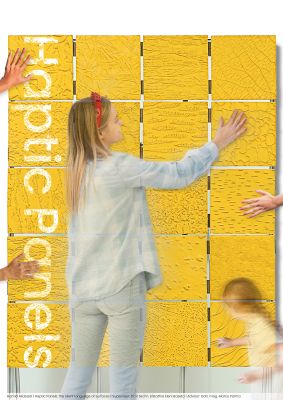
To explore this dimension, I have developed a series of experimental surface studies, termed ‘haptic panels’, which use natural textures such as dry earth, leaves, grass and others as source material. Photographs of these textures were digitally processed and manually transformed into latex panels that preserve the intended and selected fine-grained tactile details of the natural world whilst offering a rich tactile experience. The panels are divided into two categories: floor panels and wall panels.
In addition to its conceptual objectives, the project opens up new possibilities for application in multisensory, inclusive and educational design. The tactile panels can serve as exploratory tools in pre-Braille education for blind and visually impaired children.
The final project culminates in the construction of an interactive model comprising both haptic floor and wall panels. People are invited to walk on these surfaces and touch them.